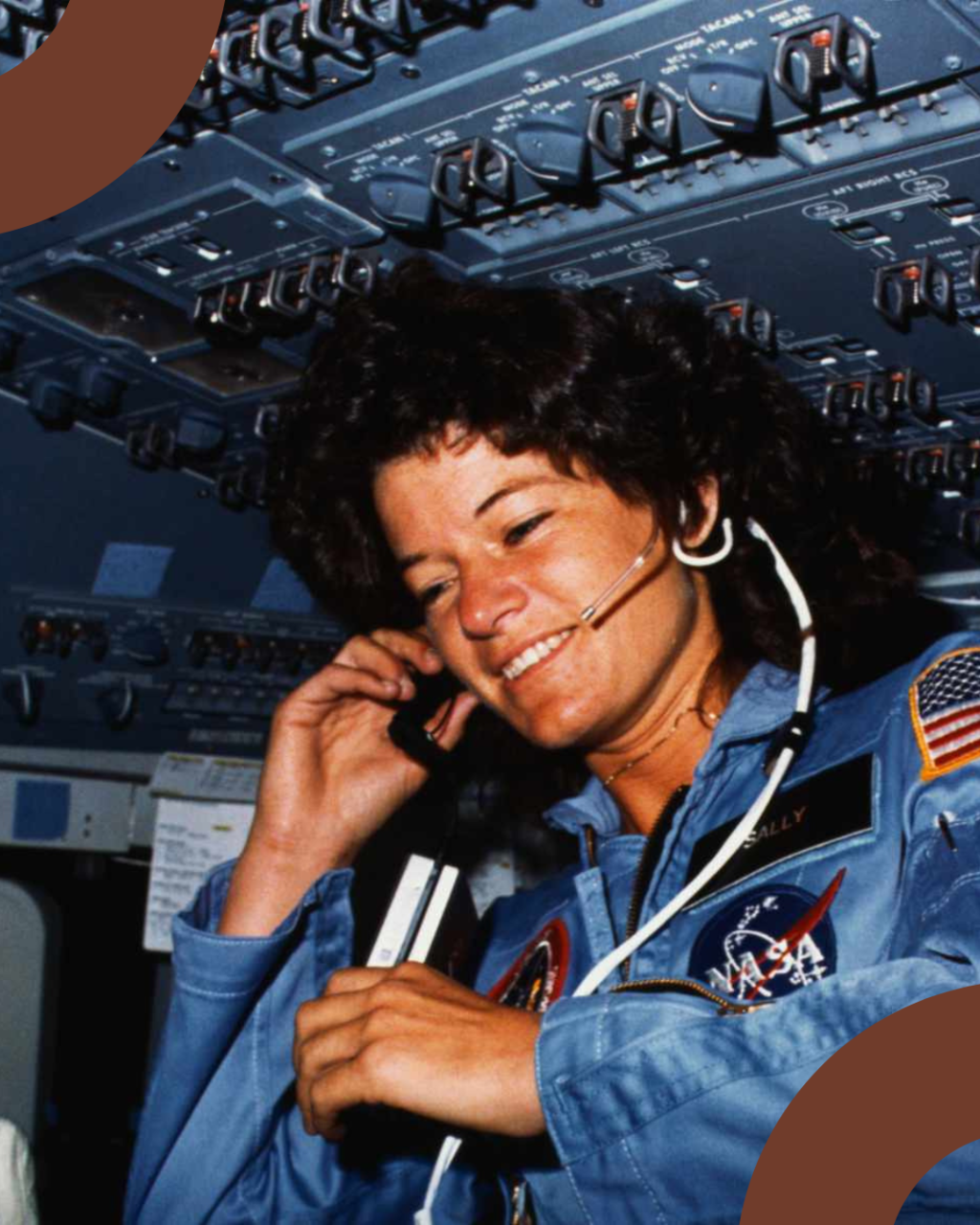
Sally Ride is an American Physicist and Astronaut who made a name for herself as the first American woman to set foot on space. Sally Ride is a pioneer female figure in modern space science and has mentored many young female physicists and astronauts to outlive her.
In this article, Justbio is celebrating her as part of our International Women’s Day celebration of women who have made marks in male dominated spheres and also making it easy for more women to onboard.
Early Life and Background
Sally Kristen Ride was born on the 26th of May, 1951 in Los Angeles. She grew up in the suburb of Encino in a supportive family that encouraged intellectual curiosity and academic achievement.
Her father, Dale Ride, was a professor of political science, while her mother, Carol Joyce Ride, worked as a volunteer counselor.
From an early age, Ride showed exceptional talent in both science and athletics and was already a nationally ranked tennis player before choosing science. She was also said to have briefly considered becoming a professional athlete but her passion for science and discovery eventually led her toward physics and space research.
Education
Sally Ride attended Westlake School for Girls, where she excelled academically and graduated in 1968.
She proceeded to Stanford University, one of the leading institutions in the United States where she pursued physics and developed a deeper interest in space science.
Her academic achievements at Stanford include:
- Bachelor of Science in Physics
- Bachelor of Arts in English
- Master of Science in Physics
- PhD in Physics (1978)
Her doctoral research focused on astrophysics and free-electron lasers, laying the foundation for her later work in space exploration.
NASA Career and Space Missions
In 1977, NASA launched a historic recruitment campaign for astronauts. For the first time, the program opened its doors to women and minority candidates.
Sally Ride applied and was selected in 1978, becoming one of the first female astronaut candidates.
She underwent extensive astronaut training, which included:
Spacecraft operations, Survival training, Robotics systems, Shuttle mission preparation.
First Spaceflight
Sally Ride made history on June 18, 1983, when she launched aboard the Space Shuttle Challenger during the mission STS-7. This mission made her the first American woman to travel to space.
During the mission, she operated the robotic arm of the shuttle to deploy satellites into orbit.
Second Space Mission
Ride flew again in 1984 on the mission STS-41-G, which conducted Earth observation experiments and further satellite deployments.
In total, she spent more than 343 hours in space.
Challenger Investigation
After the tragic Space Shuttle Challenger disaster, Ride served on the Rogers Commission, which investigated the cause of the explosion.
Her scientific expertise helped uncover the failure of the shuttle’s O-ring seals, which contributed to the accident.
Career After NASA
Sally Ride left NASA in 1987 but continued contributing to science and education.
She became a professor at the University of California, San Diego where she focused on physics research and science policy.
Promoting STEM Education
In 2001, she co-founded Sally Ride Science, an organization that was dedicated to encouraging young people, especially girls to pursue careers in science, technology, engineering, and mathematics (STEM).
Through books, educational programs, and outreach initiatives, Ride helped inspire millions of students worldwide.
Marriage and Family
In 1982, Sally Ride married Steven Hawley, fellow astronaut whom they divorced in 1987.
Sally would later get on with Tam O’Shaughnessy, who was her partner from 1985 until her death in 2012.
O’Shaughnessy was a childhood friend and later a collaborator in science education initiatives.
Although Sally Ride did not have children, she devoted much of her life to mentoring young scientists and students.
Awards and Honors
Throughout her life, Sally Ride received numerous awards and honors recognizing her contributions to science and space exploration.
Some of her most notable awards include:
- NASA Space Flight Medal
- National Space Society von Braun Award
- Presidential Medal of Freedom (posthumously)
She was also inducted into the:
- National Women’s Hall of Fame
- Astronaut Hall of Fame
These honors recognized both her scientific achievements and her influence as a role model for women in STEM.
Cause of Death
Sally Ride passed away on the 23rd of July, 2012, at the age of 61 in La Jolla.
Her death was caused by Pancreatic cancer, after a 17-month battle with the illness.
Legacy and Impact
Sally Ride’s legacy extends far beyond her historic spaceflight.
She helped break barriers for women in science and became a powerful symbol of gender equality in STEM fields.
Her influence continues through:
- STEM education initiatives
- Scholarships and science programs
- Museums and institutions named in her honor
In recognition of her contributions, the U.S. Navy even named a research vessel after her. The vessel is named RV Sally Ride
Her story continues to inspire millions of students and scientists around the world.
Conclusion
Sally Ride remains one of the most important pioneers in the history of space exploration. From her childhood curiosity in California to becoming the first American woman in space, her journey reflects determination, brilliance, and courage.
Beyond her achievements as an astronaut, she dedicated her life to education, scientific research, and inspiring future generations.
Her legacy proves that breaking barriers in science can change the world—and open the door for those who follow.